For more information on nutritional facts are of benefit to us. determines the health and risk factors. For example, when it comes to preserving and conserving the values corresponding glucose levels healthy, but when you have a higher risk of infection Persoon risk of diabetes should monitor the level of blood sugar.

Psychological tests to identify the person, in the case of many essential nutrients, minerals, when it gets beyond what is available. For diabetics, in response to self-help, psychological testing, you will know whether high or low glucose. Help test car for this type typically include questions about food, usually, and often eaten part. Salts and sugars, sweeteners are not required.

Good nutrition is important to keep in mind and healthy body. Proper nutrition can be derived from products such as fruits, vegetables, meat and poultry products. It 'also important to keep a daily intake of each nutrient needed. Balance the lack of essential nutrients can be serious health problems unaddressed. Can excessive consumption of nutrients is harmful to health and weight.

It 'also important that the nutritional value of another person. Depending on your condition and the nutritional needs of people to adapt better. If the problem is what to do with weight, can improve the events. Depending on the weight of calories and carbohydrates, especially consumption, should be corrected. Psychological self-help, you can go to celebrate the beginning of time, knowing all the facts about proper nutrition.

Network Test sufficiently self psychology to help you with your needs. This can be tested for sodium, fruits and vegetables, fats, calories, fat, replacing fat, trans fatty acids and more.

Now, you want more energy, healthier, younger, lose weight and cleanse the body, is not it?

The next time you are browsing magazines in a shop, a look at pop psychology department and see what kind of stories on their front page. You will notice a pattern monotonous titles that everyone on the hard disk (ie your) wealth or focus seems accurate, as you can "feel" to your well. Typical products are as follows entitled "Know yourself, you are" really happy to feel "attractive" or "strengthen your self-confidence and so on.

It's really all that interested people read? I am the only one, as shameless self-indulgent of our culture seems to be like? When judging magazines, it seems like we obsessed with our desire to feel good about themselves.

You could say "what that?" But aside from the obvious implications of selfishness neurotic, there is another problem. All this seems at the expense of our interest in the understanding of our environment. These journals are not self-help magazines. His journals of psychology. Psychology is a fascinating area of science, extremely important and ubiquitous in our daily lives. There are many aspects of psychology that you would expect from a psychology magazine, even if intended for the masses, would be filled with a wealth of information of job excellence.

So I am not saying that we presented to others' needs or the needs of society need us. I do not claim that our natural desire to leave a good feeling. But I think we lack a wealth of knowledge that can be more satisfying for all self-help advice.

The self-help movement really began with the advent of psychiatry, and the first revolutionary ideas of Dr. Sigmund Freud. Although Freud's ideas have been largely completed and many of them actually replace his work on the unconscious, the way we and our future revolution.

Psychology actually started with Dr. Sigmund Freud and his entourage to produce students who later became the science of psychoanalysis and technology to increase the unconscious to the conscious level of awareness. This process of clinical psychoanalysis was the first rigorous science of the mind, which has since been used as the basis for many other procedures and techniques that have spread throughout the Western world.

Our consciousness is always a great value for the spiritual traditions and the state is far from being something new in history. Since 5000 BC, it is generally accepted that the Hindu rituals and practices of mediation techniques, methods to increase their subconscious to a higher level of consciousness and monumental, were successful in many cases. Even in the absence of very detailed comments and crisp modern psychiatry, the ancient sages were incredible heights of transcendental consciousness to achieve, particularly through yoga and meditation. These practices have been a big comeback in recent decades because of the strict discoveries of psychoanalysis, as the realization that the increase can be detected in fact, lead to better health and well-being of many psychoanalytic Patienten be made .

The movement for self-help is a huge boost to the discoveries of Sigmund Freud and his best pupil, Dr. Carl Jung. Jung eventually broke with his master and has a wider application of Freud's ideas, while the importance of spiritual reality, the results of an improved level of consciousness. Freud has been widely criticized for placing too much emphasis on the role of sexuality in our growth strategy as people. Jung saw further and recognize that the spiritual ideas play an important role in our development and can be used to increase our awareness of how Freud has never seen. The work of Dr. Jung's collective unconscious and the archetypes of the spirit of contributing to our understanding of the importance of mutual support and spiritual development. In fact, it is known that the practices of Jung contributed to the growth of the clinic, the first group of twelve steps Spark today, and his specific work with the founders of Alcoholics Anonymous was the beginning of a movement that has radically changed our modern society and self-help movement.

Psychologists have played a key role in the development of self-help movement, and this trend is far from over. The most important contribution to this movement today is Dr. David R. Hawkins, who wrote a book called the most influential power against power, is the beginning of a new wave of major contributions to the advancement of higher consciousness and spiritual development. The discoveries of Mr. Hawkins in the science of kinesiology, the awareness that you can actually be measured by the internal reactions of the body to show. This discovery holds great promise for the world of psychiatry and mental growth, because the compass leads to a true spiritual seeker. Kinesiology is now used for the awareness of thousands of practical and spiritual techniques and writing, teachers and even places and things, all carry a particular feeding area can be explored directly, and reactions were included, the energy meridians in the body. The impact of this new discovery are just beginning to be recognized by thousands of people around the world.

The future is bright for the self-help and psychology, many new discoveries are made every day, soon to be transferred, as we see ourselves and those around us. It will be best for you smart people who are currently on the train itself, that the findings do make their greatest impact they have ever done.

Thoughts may be intangible expression in you. But they have a much greater effect on the whole man, in the perspective in their lives. This is the way that acts and looks situations manifested. And so it is important to have a positive belief system. You can improve and lead to a happier life, you help to build strong relationships and a better life. Outlook Your life is shaped by your childhood. If you are used to thinking negatively, it can be restructured to keep positive thoughts. This is the main goal of the psychology of the self. The method allows direct your thoughts and positive energy resulting from free on your profile. If you have a positive attitude is everything you do, which in turn makes it easy for themselves to achieve goals influence to find.

Psychology of self-help and other counseling or therapy session with professional self-esteem is the first order. Similarly, negative or limiting beliefs, you must answer the following questions on self-psychology.

1st Question deserves. That's all for you. This will help you, your feelings and how you see yourself. Value of the car, what or how little you think of yourself.

2nd Call of assets at risk. Whether you are in a position, objectives and expectations are set for ourselves or less everything, how big to think for yourself. Make sure that we can to work with your plans and to work for your personal success. You must be a hundred percent. They believe that we absolutely yes!

3rd The question that is desirable. When working on your dreams a reality, it is important to commit to fundamental values. No matter how bad a thing, if you drive, to go against what the virtues which have always claimed, you are not completely satisfied. Self psychology teaches that every aspect or element, and must live in harmony. This includes actions and your values.

4th Interview opportunity. You have to believe to follow ahead of the other. Once a target and a plan designed to achieve it, make sure. You lose your doubts. You need a strong will. So, if everything seems to go against their way, will see through your faith. Will drive to persevere until they achieve their goal.

5th On the question of the result. You can pay to reach your heart and soul to their destination, then it must something you're passionate, somewhat, what I will be more than anything else.
Trust is the basis of the psychology of the self. You may be restrictions. It can be as great as your leaves.

Are you exhausted all the news from the financial crisis? The media seems to be inundated with contradictory messages about the depth of the recession and its impact on all aspects of the economy. Although the best advice is always so, as always, "Do not worry and do not sit down," the greatest news the Opposite WAS: Many people fear more Than to see and hear.

Energy Psychology Self-help for the rescue!

Over the past twenty years I have energy psychology techniques to help myself and my clients always difficult. Now is the time you want to know what you actually get close to you biting your nails and the nation went off financial worries can help you.

Here are some tips practical:

1) to confirm your strengths and resources with the statement: "I always had enough love and money to support me ... I swear, keep enough money for me." (Attention, love and connection with others is more important than money.)

2), coming alongside the competition venue at the top center of the chest (for example, where the Americans would pledge allegiance to mention), but noted: "While markets luainiú, and I accept the honor, and then take me to calm down. "Make ngníomhachtaíonn 3-5 times, each time that your negative thoughts.

3) Notice how the fear of the future on a scale of 1-10. Tap gently 10-15 times acupuncture meridian points on the intersection of the nose and eyebrows, has rejected the edge of the bone structure of external eye, directly under the eyes, nose, collarbone and hand points, but "I have expressed, fear and anxiety about the financial future "at any point.

4) positive religious installed your strengths and resources of your relatives, your gifts and strengths. Tap the same order in paragraph 3, stating your positive belief. Example: "I had the strength and resources I need to pass through the critical moment." (If you are unsure of the strength that you are asking them to come to the statement, "I now have the resources needed to get through this crisis period of abstinence.")

5) Note the difference in your anxiety rating scale. Even if nothing changes in the external world, to ensure that they are actually responsible for your life and appreciate the quality of life. Someone can 'make your soul, the essence. As said the wise elders of other moments of danger in history, "I have nothing but the fear of fear itself."

Continue blessing enough numbers. Despite the financial turmoil and changes in current market situation, "We are happy to live in this country and we have chosen life. Stay as positive as possible and trust in the beauty of the surroundings and family You and your gifts. Known as luainiú that the actual value, and also trade in the markets.

The Human Brain Book by Rita Carter

I've been able to purchase and read several books this past spring and summer.  I will be posting about several of them.  The first summer review is The Human Brain Book by Rita Carter (the subtitle is "An illustrated guide to its structure, function, and disorders).  The book makes for not just a great coffee table book (it's over sized), but also includes a DVD that has some additional features one can use in class. The publisher is D/K, the wonderful publishers whose books are among my favorites.


Oh, how I wish I had a book like this when I began teaching psychology.  From a visual learner's point of view, this book hits the jackpot. It begins with a history of studying the brain, landmarks in neuroscience and photos of a series of brain scans.  You know all those pesky little questions that your students ask, but you're not sure of the answer because your neuroscience course was 20+ years ago and the images (I mean drawings) were in black and white?  This book has those answers.  There are 70+ pages of pictures and explanations of brain anatomy (all the parts, not just the ones in our texts), brain zones, neurons, and research to satisfy the best of us. 

This book has a chapter on the senses, one on movement and control, emotions and feelings, the social brain, language and communication, memory, thinking, consciousness, the individual brain, development and aging, and concludes with diseases and disorders.

Although I have not read every word on every page, just for the illustrations, I am giving this book my highest recommendation.  It is a must for every psychology class.  Order by clicking below.  You will not be disappointed.


Posted by Chuck Schallhorn

Time Magazine Two-fer

Time magazine (July 19, 2010 issue) came out today with a cover story about the "Myth of Only Children."  The article goes over the claims by G. Stanley Hall in the early work of developmental psychology.  The fight of research conclusions attempting to go against popular thought is explored along with the research citations.  Current stats along with various quotes from only children and an examination of families and their decision making process are included.

There is some good background/history of psychology research discussed as well as the social/economic context for having larger families and the current changes many couples are dealing with.

A second article on hoarding and the emotional attachment to things follows the cover story article.  Check it out here at "Cleaning House."  In addition to the disorder, the article examines the television imitations to "Hoarders" on A and E television.


Posted by Chuck Schallhorn

You Are Not So Smart


For me, this blog falls under the category of "Why didn't I find this before?" David Mcraney (who describes himself as a a journalist who loves psychology, technology and the internet") writes a provocative blog called You Are Not So Smart where he posts thoughtful musings about common "misconceptions", such as:

  • Most opinions are the result of years of rational, objective analysis.
  • In romance, opposites attract.
  • After you learn something new, you remember how you were once ignorant or wrong.
These ideas probably seem familiar to most of us psychology teacher-types - we talk about them (often in the research methods or social psych. chapters) and often they start lively, important discussions in the classroom.

I've always wanted to have a psychological version of the great "Bad Astronomy" webpage, and this blog comes darn close, in a way.

(personal note: I found out about this blog through a great friend, Jim Hanna. Thanks Jim!)


posted by Rob McEntarffer

I had a lovely young woman come in to tell a story of violence. She was claiming compensation for a specific event of violence. The premise of compensation is that society pays for an injury that results from the violence. Life or "functioning" in psychological speak has got to have got worse as a result of the violence to claim compensation.

She had a miserable life. She lived in our very anglo-celtic town and was from a mixed heritage background. She suffered what we all dread for our children - merciless bullying. She was called ugly to her face because she had obvious racial characteristics thought unattractive by simple, basic, culturally poor children. I felt ashamed to be anglo.

Her mother and father separated and her mother brought her up in way thought abusive in our culture, possibly just "traditional" in her own. Regardless the girl felt unloved and completely alone. She began self-harming with enthusiasm and began acting-out at home. The bullying continued well into high school and she had sex at thirteen to try to fit in. She had sex and just kept going, doing anything to find acceptance.

At a party some eight months ago she was assaulted. bashed by three girls no less. She suffered bruising and swelling around the face and a bleeding nose. Most importantly perhaps she was deserted by every one else at the party. She walked around town for half an hour looking for someone to help. she was taken to hospital by ambulance.

So the outcome was she changed schools and is now popular. She fits in. she has found God and has found her sexual integrity. She was just congratulated for excellent academic success at her new school. what a wonderful outcome!

Pop Psych, Scientific Psych and the 50 Myths

I'm catching up on podcasts that I missed during the pre-grad and graduation time.  I caught this Point of Inquiry interview with Scott Lilienfeld, author of 50 Great Myths of Popular Psychology: Shattering Widespread Misconceptions About Human Behavior.  The interview is a solid one which can describe for teachers (and advanced students) that makes the distinction between scientific and pop psychology.  He and the interviewer also go through a number of the myths covered in the book.  Great reading and great listening.


Posted by Chuck Schallhorn

Guilty Except for Insanity


This is a new documentary about the Oregon State Hospital (made famous by One Flew Over the Cuckoo's Nest). It documents the struggles of 5 people in the hospital. It also touches on the history of mental hospitals and the legal struggles these patients face.

http://www.guiltyexcept.com/index.php

It was shown in Portland at the end of June and there is no word on when the full version will be available for the public, but there is contact information for the people involved in the documentary.

Here is little excerpt from the website:
"Guilty Except for Insanity follows the journeys of five people who enlist the insanity defense after being charged with serious crimes. The documentary portrays the circumstances surrounding their crimes and the dilemmas they confront as they enter the Oregon State Hospital under the "guilty except for insanity" plea."

-posted by Trevor Tusow

Poll Everywhere


This post comes to you from the Pacific Northwest! I (Rob) got to work with some FABULOUS teachers at the AP Psych Institute in Bellevue, WA, and we worked with an interesting website this morning: Poll Everywhere
http://www.polleverywhere.com/

This site allows you to post a multiple choice question for folks (students and/or teachers in a prof. development course, etc.) who can then text in a certain code and "vote" on one of the options. At our institute we used poll everywhere as part of a discussion about "Formative Diagnostic Items" - a formative assessment technique that helps teachers quickly gather data about student misconceptions.

(By the way: My participants are the BEST participants ever in the history of AP Psychology institutes. So there)

- posted by Rob McEntarffer

How to unextreme an extremist

How do people move away from their extremist beliefs? When an individual leaves a terrorist organisation do they change their attitudes and beliefs or do they just stop acting on them? How often do individuals leave one extremist organisation and replace those beliefs with other extreme beliefs? Do they hold similar values and just moderate them a bit? If governments around the world address disenfranchisement and bring the extremists "into the tent" does that deradicalise them?

What a fantastically interesting area to pursue for a Phd. My lovely friend Kate has the untold luxury and burden of trying to answer these questions for the next two years. She is already one year in and these days we only have a strict three year time frame for each Phd. She has the privilege of interviewing the fair dinkum extremists who have walked away. She gets to get to know why they no longer belong to the groups that throw the bombs. Did they change, or have they just changed how they do it? fascinating

Donors Choose projects for psychology teachers

help with technology

i need some help with the technology I struggle with. if anyone out there reads this stuff you might notice i dont respond to comments. the problem is all the comments i receive are written in japanese script! no matter who posts the comments! i am missing a whole lost of interesting comments and i'd love to respond or at least see if people think i write crap. If you have any suggestions for how to fix the problem please e-mail me to make a suggestion: katman2@dodo.com.au

Slogans and behavior - it's time for change

Okay, teachers, trust me on this one -- file it away for next year and bring it out when you want your students to apply their knowledge to a real-world setting.

The Wall Street Journal today posed a question: what's the best preventive health slogan for kids? The story focuses on Blue Cross Blue Shield's new "5-2-1-0" campaign (PDFs in English and in Spanish) to teach healthy habits and reduce the amount of obesity and prevalence of diabetes by encouraging children to do the following everyday:
  • 5 servings of fruits and vegetables a day
  • 2 hours or fewer of screen time
  • 1 hour of physical activity
  • 0 unsweetened drinks
As Katherine Hobson implies in the WSJ, though, "5-2-1-0" is not terribly catchy, and public service campaigns in general aren't as popular as slogans produced by the private sector in large part due to the vast differences in advertising budgets. She states that with rare exception, slogans like "Just Say No to Drugs" aren't as memorable as "Coke is it."

So here's your assignment, in three parts:
1) Have your students redesign the 5-2-1-0 campaign using what they have learned in psychology. This would be a perfect time to include subjects like operant and classical conditioning, memory, motivation, persuasion, etc. Can they create something that would be more memorable and most importantly that would lead to behavior change? (And how could you measure whether it was successful?)

2) See if your students can counter Hobson's article. For every "Coke is it" there are surely many other private sector ad campaigns that fall flat, and maybe there are more catchy public service slogans out there than she points out. "Fried Egg," also known as "This is Your Brain on Drugs," for example, was a PSA created by the Partnership for a Drug-Free America. "Friends Don't Let Friends Drive Drunk" is another memorable PSA. How many others can they think of?

3) How effective are PSAs in general at changing behavior? Have your students identify an issue, find the slogans used to encourage behavior change and then look for evidence that the behavior actually changed during the time that the slogan was used. Did "Just Say No" or "Fried Egg" really change behavior? Help them find the evidence that would support or reject these claims.

--posted by Steve

racism at my table

racism is always confronting. it is especially difficult when it comes out of the mouth of a family member. Someone who will always at your diner table at family functions but with atrocious values. My brother in law began the tirade about the migrants who are violent criminals. He argued that Sydney is going down the toilet because of these migrant gangs. He sees them "everywhere" and they are responsible for violence and crime.

Psychology can explain racism. it can explain that we have a tendency to attend to the bits of information that confirms our attitudes but we ignore the bits that don't. So my brother in law only sees and only remembers the examples of the migrant violence but conveniently ignores the violence caused by anglo celtic aussies.

The other bit of psychology is much more personal ( in a way). Any forensic psychologist can tell you that people behaving badly are every where. They come from all backgrounds, all races. They are more likely to be uneducated, illiterate, not very smart. They are often traumatised and have been exposed to violence, they are dispossessed and without resources. Forensic psychologists can tell you that shit is not race specific.

Unfortunately bigoted and uneducated racist men don't often want to listen to the wisdom of university educated women. ah...pass the bottle of wine.

sex offender making restitution

so we have a convicted child porn watcher. he is fairly true to type. He is middle aged, unmarried, lonely. He is ineffectual and unable to maintain normal romantic attachments. Not because he is particularly repulsive, just because he hasn't quite sharpened the skills necessary. He developed a bit of an OCD quality to his computer and internet use. At one stage making sure he had every image or page of a particular topic "covered" and then another topic. One month it was Australian warships, the next it was organic gardening. I'm not kidding.

SO then it was pornography. This time it was "the worst possible thing" he could look at. In some ways he continued to look at it to make sure he was still horrified by it. A bit like poking a tooth decay hole to make sure it still hurts. He handed over his credit car details and purchased images.

Needless to say he was eventually tracked down and sent to me for treatment. We needed to deal the sexual interest of course, with social isolation, with alcohol abuse. We also needed to deal with the guilt he felt. He was completely wracked by it because his activity was , by definition, "the worst possible thing" he could look at. That why he did it. Weird concept to get your head around, I know.

One very important part of treatment was identifying the guilt and doing something about it. As it was it was just contributing to self loathing and more drinking. we looked at the idea of making restitution. Of "balancing out the universe" and doing something good for others that no one else knows about. He loved the idea. He felt some relief. We settled on anonymous blood giving to the blood bank. He could do something good that no-one need know anything about, to balance the anonymous bad stuff that no-one should have known anything about. Kind of neat solution?

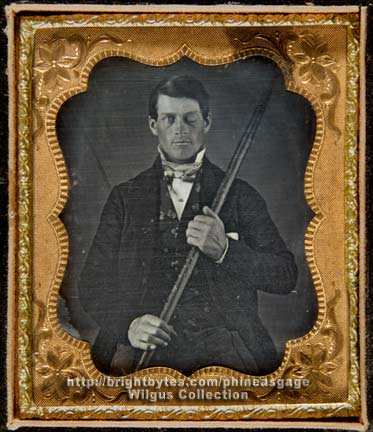
Phineas Gage news

(Photo via the collection of Jack and Beverly Wilgus)

This past Friday was the 150th anniversary of the death of one of psychology's all-time favorite subjects, Phineas Gage. Today in Vermont (as I learned via ScienceBlogs) the Cavendish Historical Society is holding a walking tour of famous sites related to Gage including the accident site itself, the home of Dr. Harlow (the surgeon who treated Gage) and the house that Gage was taken to after the accident.

The newsletter of the CHS published earlier this month gives some great historical background to Gage's accident, including this reference from the local newspaper on the following day:
Horrible Accident: As Phineas P. Gage, a foreman on the railroad in Cavendish, was yesterday engaged in tamping -for a blast, the powder exploded, carrying an iron instrument through his head an inch and a fourth in circumference, and three feet and eight inches in length, which he was using at the time. The iron centered on the side of his face, shattering the upper jaw and passing back of the left eye and out at the top of the head.

The most singular circumstance connected with this melancholy affair is that he was alive at two o’clock this afternoon, and in full possession of his reason, and free from pain. Ludlow Vt. Free Soil Union Sept. 14, 1848
Also this week was a post on Mind Hacks by Vaughan Bell who found a recent journal article with more details about Gage's life after the accident. Don't just settle for "Gage was no longer Gage"; as Malcolm Macmillan and Matthew L. Lena published in Neurophysiological Rehabilitation, Gage continued to work for the twelve years following the accident, seven of them as a driver in Chile, and at one point was examined by a doctor who found "no impairment whatever." The Mind Hacks post has been updated to include a link to the actual journal article as well.

P.S. Coming this summer: a post on the top ten subjects in psychology? I'm thinking Gage, Little Albert, the Bobo doll, Piaget's three kids, Lorenz' geese, Zimbardo's prisoner #819, etc. Who would you nominate?

-- posted by Steve

Psychology Position in Clintonville, WI

A full-time teaching position for the 2010-2011 school year has opened up at Clintonville High School in Clintonville, WI (35 miles west and slightly north of Green Bay). The assignment includes: AP Psychology, Sociology, World Studies and US History.

Full details of the job can be found at
http://ww2.wisconsin.gov/state/employment/app?COMMAND=gov.wi.state.cpp.job.command.ShowJobDetails&selectedJob=201005121339521476804 Applications must be sent by May 28th.

If you have information on a high school teaching position which includes psychology that we can post on the THSP Blog, please contact Kent Korek at kkorek@germantown.k12.wi.us. Best of luck to everyone looking for an opening.

News from TOPSS

Below is the latest news from Emily Leary (Eleary@apa.org) regarding the Teachers of Psychology in Secondary Schools (TOPSS).

2010 TOPSS Committee Elections

The mission of the APA Committee of Teachers of Psychology in Secondary Schools (TOPSS) is to promote the scientific nature of introductory and advanced high school psychology; to meet curricular needs of secondary school teachers; and to provide opportunities for high school students to be recognized and rewarded for their academic excellence. If you would like to become more involved in TOPSS, we encourage you to consider serving on the TOPSS Committee. TOPSS is especially interested in encouraging individuals from diverse backgrounds (including diversity in race/ethnicity, gender, ability/disability, sexual orientation, age, and religion) to consider running for TOPSS Office. In 2010, the following three elected positions will be filled:

  • Chair-Elect
  • Member-at-Large (2)

The Chair position is a three-year position and the Member-at-Large positions are each two-year positions. Please consider nominating a colleague who would make a positive impact. We encourage teachers to consider volunteering to be a candidate for the TOPSS Election Ballot. Nomination materials should be submitted by July 1, 2010. For more information, visit http://www.apa.org/ed/precollege/topss/call-for-nominations.aspx.

2010 APA TOPSS Excellence in Teaching Award Recipients

The TOPSS Committee congratulates William James of Milford High School (Highland, MI) and Scott Reed of Hamilton High School (Chandler, AZ) for being selected as recipients of the 2010 APA TOPSS Excellence in Teaching Awards. The TOPSS Teaching Awards recognize outstanding teachers in psychology. The award recipients will receive a framed certificate, award, cash prize of $300, ActivePsych CD series, and a free TOPSS membership or renewal for the 2011 membership year. The ActivePsych CD series has been generously donated by Worth Publishers. Congratulations, Bill and Scott!

2010 APA TOPSS Scholars Essay Competition Winners

The TOPSS Committee congratulates the student winners of the 2010 APA TOPSS Essay Competition. Sabina Babar of Colonia High School (Colonia, New Jersey), Rachael J. Erickson of Sutton Memorial High School (Sutton, Massachusetts), Allison Gutworth of Colonia High School (Colonia, New Jersey), and Alexis Suskey of Grandville High School (Wyoming, Michigan) each received $250 scholarships for their winning essays. The 2010 essay question asked students to focus on the effects human behavior has had on the current environmental crisis.

Information about the 2011 APA TOPSS Excellence in Teaching Awards and the 2011 APA TOPSS Scholars Essay Competition will be announced during the fall of 2010.


Posted by Kent

Teaching Positions

As many of you are painfully aware, there are a large number of school districts across the country laying off staff. In some places hundreds of teachers are being given pink slips.

We here at the Teaching High School Psychology Blog would like to do what we can to help connect teachers with job openings. If anyone is aware of a teaching posting which includes psychology as part of the assignment, please send the information to Kent Korek at kkorek@germantown.k12.wi.us. I will then post the information on the THSP blog.

In the AP Courses and Exams section of the AP Central website (http://apcentral.collegeboard.com/apc/Controller.jpf), you will find all of the AP Psychology Free Response Questions since 1999 along with various other documents pertaining to the FRQs. Many people have difficulties finding the documents from 1999-2002 as they are on a different web page. To make it easier for teachers, below you will find links to the AP Central documents. Please report any faulty links to Kent Korek at kkorek@germantown.k12.wi.us

2010 (Please note: some of the below items have not yet been published)

Free Response Questions 1 & 2
FRQ Scoring Guidelines (Rubrics)
Student Performance Q&A
FRQ Scoring Statistics
Sample Response Question 1
Sample Response Question 2
Overall Grade Distribution


2009

Free Response Questions 1 & 2
FRQ Scoring Guidelines (Rubrics)
Student Performance Q&A
FRQ Scoring Statistics
Sample Response Question 1
Sample Response Question 2
Overall Grade Distribution


2008

Free Response Questions 1 & 2
FRQ Scoring Guidelines (Rubrics)
Student Performance Q&A
FRQ Scoring Statistics
Sample Response Question 1
Sample Response Question 2
Overall Grade Distribution


2007

Free Response Questions 1 & 2
FRQ Scoring Guidelines (Rubrics)
Student Performance Q&A
FRQ Scoring Statistics
Sample Response Question 1
Sample Response Question 2
Overall Grade Distribution


2006

Free Response Questions 1 & 2
FRQ Scoring Guidelines (Rubrics)
Student Performance Q&A
FRQ Scoring Statistics
Sample Response Question 1
Sample Response Question 2
Overall Grade Distribution


2005

Free Response Questions 1 & 2
FRQ Scoring Guidelines (Rubrics)
Student Performance Q&A
FRQ Scoring Statistics
Sample Response Questions
Scoring Commentary on Sample Response Questions
Overall Grade Distribution


2004

Free Response Questions 1 & 2
FRQ Scoring Guidelines (Rubrics)
Student Performance Q&A
FRQ Scoring Statistics
Sample Response Question 1
Sample Response Question 2
Scoring Commentary on Sample Response Questions
Overall Grade Distribution


2003

Free Response Questions 1 & 2
FRQ Scoring Guidelines (Rubrics)
Student Performance Q&A
FRQ Scoring Statistics
Sample Response Question 1
Sample Response Question 2

Scoring Commentary on Sample Response Questions
Overall Grade Distribution


2002

Free Response Questions 1 & 2
FRQ Scoring Guidelines (Rubrics)
Student Performance Q&A
FRQ Scoring Statistics
Sample Response Question 1
Sample Response Question 2
Scoring Commentary on Sample Response Questions
Overall Grade Distribution


2001

Free Response Questions 1 & 2
FRQ Scoring Guidelines (Rubrics)
Student Performance Q&A
Sample Response Question 1
Sample Response Question 2
Scoring Commentary on Sample Response Questions


2000

Free Response Questions 1 & 2
FRQ Scoring Guidelines (Rubrics)
Sample Response Question 1
Sample Response Question 2


1999

Free Response Questions 1 & 2
FRQ Scoring Guidelines (Rubrics)
Sample Response Question 1
Sample Response Question 2
Scoring Commentary on Sample Response Questions

domestic violence dilema

I know this has taken a while. Things have been very busy at Peninsular Psychology. We have moved into a new sunny little house with polished floor boards and lots of room. We are all in love with it - our clients especially.

So back to work.

I was confronted only recently with the dilemmas of leaving a violent marriage. She put up with his controlling violence for years. Ended up sleeping with the kids in one room with a chair against the door. He gave her no money and no access to the car. They lived on a country property and he cut off the phone. Eventually she was discovered by a community service. The women who came to her rescue assisted her to leave with her kids. The settled her in a new house - happy days.

So the interesting twist is that she has no more access to anything in her previous home. her ex changed the locks and it has now become "a civil matter" so of no interest to police. She and the kids had to leave with nothing. They are safe but destitute. he of course pays no child support and she has to deliver the kids to him once a week, despite their tears.

I'm left thinking, there has got to be a better way. They must be a way to remove the offender and leave the family in the home. There must be a way to do this immediately through he criminal justice system without relying on the often two year process of family law. There must be a way to avoid this mess.

The all new invisible gorilla!


Trust me, psych teachers -- give the above video a try. Thanks to ScienceBlogs.com for first posting this!

If you're interested in learning more, check out invisiblegorilla.com -- Christopher Chabris and Daniel Simons have a new book on the subject of attention coming out this week.


--Posted by Steve

Most prescribed psychiatric drugs and more infographics

The above infographic is from GOOD Magazine and displays the 10 most prescribed psychiatric drugs in the U.S. in 2009. More drugs were prescribed than there are Americans!

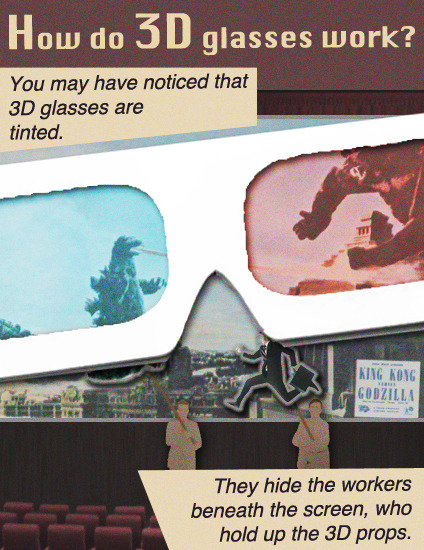
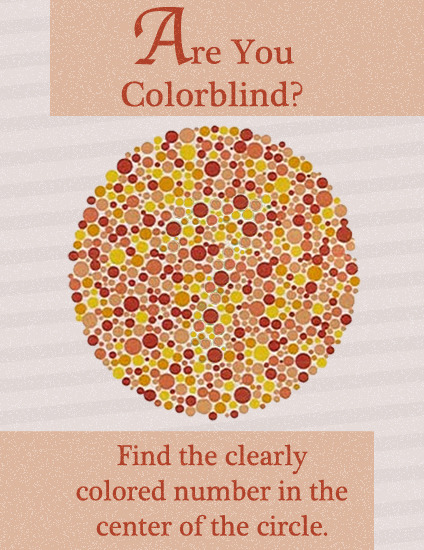
Here are some other psych-related infographics:
How to trick your brain (Boston.com)

Which countries are the happiest? (GOOD)

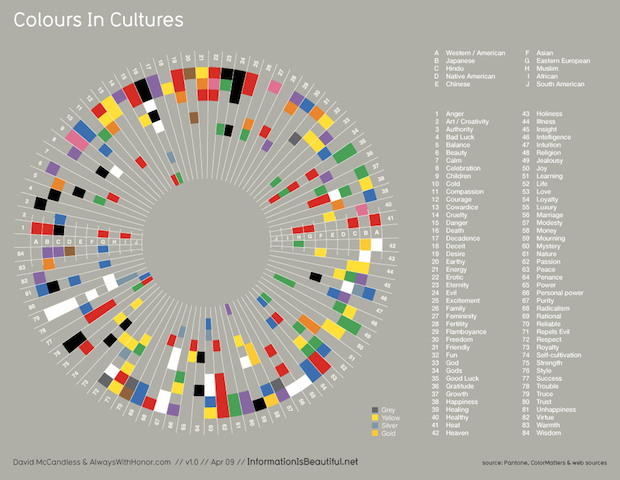
How colors are perceived in ten countries (Information is Beautiful)

And don't forget, before putting too much faith in an inforgraphic, to note this warning.


--posted by Steve

Fake Science!

In case you and your students need a little break after the AP! Maybe we can have our students work on more psychology posters like these over the next month?

You can find more of these at http://fakescience.tumblr.com/. --posted by Steve


Here's wishing everyone, students and teachers, the best of luck on today's (05/11/10) AP Psychology Exam.

Teaching High School Psychology Blog Moderators

Psychology Today Blog - Head of the Class


I just discovered that the excellent Dr. Dana Dunn (long-time AP psychology exam reading Table Leader, wonderful college psych teacher, and all around great guy) writes a blog about teaching psychology for the magazine Psychology Today. The blog is called Head of the Class, and I'm just starting to dig into the archives. The current post is about grading, and Dana gets into the topic in a funny and useful way, I think. I suspect Dana would love comments from high school psych teachers (I added one!).


posted by Rob McEntarffer

With the AP Psychology Exam just one week away, many of us are reaching the end to a long journey that started last September. Below are some of the "last minute" items I tell my students. Note: This listing is basically the same as the last minute items I posted last year at this time.

General Information:

  • Tuesday May 11, 2010 in the afternoon
  • Bring pencils with erasers and blue or black pens
  • Bring a watch that does not beep
  • Do not wear any psychology related clothing
  • Do not bring anything else: books, papers, calculators, cell phones, etc.
Multiple Choice Section:
  • 100 multiple choice questions
  • 70 minutes
  • 2/3 of the overall grade
  • A-E Answers
  • Names, charts, graphs, drawings are all possible
  • 1/4 point adjustment for guessing
Free Response Section:
  • 2 required Free Response (essay) Questions
  • 50 minutes
  • 1/3 of the overall grade - 1/6 of grade for each question
  • Points are given for correct responses not taken away for incorrect material
  • Points can only be removed if one part of an answer contradicts another part
  • Read through both questions before doing anything else
  • Think through the answer before starting to write
  • Write an outline or notes in the test question booklet
  • Don’t be afraid to cross something out, if needed
  • Write in sentences - DO NOT OUTLINE OR BULLET YOUR ANSWER.
  • Be as complete as possible, but keep to the point.
  • Watch the time. Don’t get caught short on essay #2
  • Structure the answer following the structure of the question
Test Security:
  • Do not discuss the multiple-choice section with anyone
  • Do not discuss the free response questions for 48 hours. The general rule of thumb is wait until the questions have been posted on the College Board website
  • Do NOT post, text, email etc. anything about the exam on the Internet, especially on Facebook, Twitter or other social networks
  • Do not come and visit me between the multiple choice section and free response section
If you have any questions on the above items, please contact me at kkorek@germantown.k12.wi.us Please feel free to leave any other ideas in the comments section below. Best of luck to everyone.

Babies - the Movie


Just in time for Mother's Day comes a French documentary called Babies. From the website's synopsis:

Directed by award-winning filmmaker Thomas Balmès, from an original idea by producer Alain Chabat, Babies simultaneously follows four babies around the world – from birth to first steps. The children are, respectively, in order of on-screen introduction: Ponijao, who lives with her family near Opuwo, Namibia; Bayarjargal, who resides with his family in Mongolia, near Bayanchandmani; Mari, who lives with her family in Tokyo, Japan; and Hattie, who resides with her family in the United States, in San Francisco.
Sounds like this is going to be a MUST for future development units! If you see the movie soon and want to post a review, please let me in know in the comments and you can have your own guest post!


-- Posted by Steve

The Cognitive Bias Song!


Nice! This song (above) was created by a real-life AP Psychology teacher and hit the trifecta today of being featured on Freakonomics, Boing Boing and was Tweeted by the insanely great @vaughanbell. The teacher is Brad Wray and he teaches at Arundel High School in Gambrills Maryland. Well done Mr. Wray! I've send him an e-mail and hope to post an interview with him soon.

Enjoy as you're reviewing for the AP next week ...
-- Posted by Steve

MIlwaukee Area Teachers of Psychology Meeting - May 13th

Since 1993, Milwaukee area psychology teachers have gathered twice a year to share teaching ideas and develop friendships. Our group has come to be called the "Milwaukee Area Teachers of Psychology" (MATOP) even though many come from outside the Milwaukee metropolitan area. Below you will find an agenda for our next meeting on May 13th. If you live within driving distance of the Milwaukee area, please feel free to attend. If you would like to be included on the MATOP mailing list please contact me at the email address below.

For those of you not within driving distance of Milwaukee, feel free to "check out" our agenda for items you might find useful in your classroom. Whenever possible, I have tried to include email or website addresses for further information. Please contact me with any questions you may have.


The Milwaukee Area Teachers of Psychology (MATOP) Fall Meeting will be held on Thursday May 13, 2010, 7:00 PM, at Pius XI High School, 135 N. 76th Street, Milwaukee, WI 53213 in the library.

Our agenda includes:
  • an introduction to the brand new Myers' Psychology for AP. David Myers has adapted his popular college textbook used by many AP Psychology teachers to fit the specific needs of Advanced Placement Psychology. Thanks to the generosity of Eileen Tanania, the Bedford, Freeman and Worth representative (866-843-3715 ex 714) etanania@bfwpub.com we have examination copies for everyone attending our meeting. To learn more go to http://www.bfwpub.com/highschool/
  • new information on the Quizlet Flash Card Website (www.quizlet.com) Recently both Quizlet and MATOP have made some changes to the flash card website.
  • a review of Psychology and the Real World (1st edition) from Worth Publishers www.worthpublishers.com Quoting from the Worth website, "Psychology and the Real World: Essays Illustrating Fundamental Contributions to Society is a collection of brief, personal, original essays, ranging in length from 2500 to 3500 words, in which leading academic psychologists describe what their area of research has contributed to society..... The book is unique the world of textbook ancillaries in that it does not reprint writings. Rather, innovative psychological scientists clearly and entertainingly tell readers why their research matters and how their line of inquiry developed. This text would be perfect for a regular high school level class which emphasizes the application of psychology into our lives." Eileen Tanania, the Bedford, Freeman and Worth representative (866-843-3715 ex 714) etanania@bfwpub.com has sent enough copies for everyone coming to our meeting. A special thanks to Eileen for sending two major items for our meeting.
  • thoughts about the 2010 AP Psychology free response questions released earlier the afternoon of the MATOP meeting. The FRQs, rubrics, sample responses, etc. from previous years can be found at http://apcentral.collegeboard.com
  • discussing the date change for the AP Psychology Exam and the ramifications. For many years the exam has been on Tuesday of the second week of testing (i.e. May 11 in 2010). In 2011 the AP Psychology Exam will move to Monday of the first week of testing (May 2) which for many will be the day back from Spring Break.
  • discussing the potential of an AP Psychology Quiz Bowl for the spring of 2011. In many cities around the country, AP Psychology students from multiple schools gather in a competition style event. We will determine if interest exists in the Milwaukee area to sponsor such a quiz bowl and discuss what format the event might take.
  • announcing a new regular Psychology textbook. After a short hiatus, Cengage Learning is returning to the high school psychology market with the release of Psychology: A Discovery Experience by Steven Franzoi of Marquette University. Everyone attending our meeting will receive an examination copy of this book thanks to Mary Sommers (608.846.2174) Mary.Sommers@cengage.com To find out more about this new text, go to http://school.cengage.com/
  • activities from PsychKits. Earlier this spring, PsychKits introduced a newly designed set of inversion goggles. These goggles literally "turn the world upside down" for whoever is wearing them. One lucky person will be leaving the meeting with their own set of goggles. More information on PsychKits can be found at www.psychkits.com
  • plus much more
Everyone is welcome to attend at no charge. There is no need to RSVP. Please feel free to invite anyone you feel might be interested in coming. If you would like to be added to the MATOP email listing, please contact Kent Korek at kkorek@germantown.k12.wi.us For directions to Pius High School, 135 N. 76th, Milwaukee, WI 53213 go to http://www.piusxi.org/prospective/Transportation.aspx Our meetings usually last about two hours.

Psych Week on Discovery Health

Discovery Health is featuring psychology -- or to be more precise, abnormal psychology -- in a series of programs to air May 2 - May 6 that they are calling Psych Week 2010. The program line-up is as follows:

Sunday @ 9 - Anxious (anxiety disorders)
Sunday @ 10 - Enraged (people with uncontrollable anger)
Monday @ 9 - The Woman with Multiple Personalities (dissociative identity disorder)
Tuesday @9 - Born Schizophrenic (featuring the same young girl Oprah interviewed)
Wednesday @9 - My Strange Addiction (addictions)
Thursday @9 - Bipolar Mysteries: Families in Crisis (bipolar disorder)

Also, according to the press release, there is more online: "Online at DiscoveryHealth.com, visitors can access a comprehensive Mental Health Guide, as well as quizzes, slide shows and Q&A with renowned experts. The site will also feature special blog posts on mental wellness and exclusive video content, including webisodes from select PSYCH WEEK programs."

(Thanks to the multiple posters on the AP Psych list and Nancy F for pointing this out!)

-- posted by Steve

Smithsonian Magazine-Memory and More

I've been reading from Smithsonian magazine for a number of years, but had never thought to visit their website due to the relatively few directly psych-related articles in the paper-version.  In their most recent issue (May 2010) there is an excellent article on memory and how memory works.

 As I perused the online version of the article, I noticed that they had several other sections with articles of note.


Articles on the Brain
Articles on Psychological Issues/Topics
Thought Innovation & Behavior--which could have some articles of interest


Overall, if you like to read quality writing on any topic, I recommend the magazine/website.  Great stuff there.

Posted by Chuck Schallhorn

Enhancing the Teaching of Psychology Conference - UW Green Bay

The 10th annual Enhancing the Teaching of Psychology Conference will be held on May 19, 2010 at UW-Green Bay. The scheduled talks include:

Helping Students Distinguish Science from Pseudoscience

- Scott Lilienfeld (Emory University)


Threshold Concepts in Psychology

- Jeff Henriques (UW-Madison)


U-Pace Instruction: Enabling a Diversity of Students to Succeed

- Diane Reddy, Raymond Fleming, Katie Ports, & Rodney Swain (UW-Milwaukee)


Teaching sensitive/controversial/resistance-prone subjects

- Cyndi Kernihan (UW-River Falls)


Learning from Disasters

- Elizabeth Yost Hammer (Xavier University)


DSM_V: Some answers, opinions, and the story so far

- Scott Lilienfeld (Emory University)


How much Feedback is Good feedback: Developing Writing

- Illene Noppe - (UW-Green Bay)


Teaching with Technology

- Tanya Joosten (UW-Milwaukee)


Early Bird Fee (prior to April 29 deadline):
$30 per person
$25 per person departmental rate (4 or more registrants per school – registration and payment must be sent together)
$15 High School Teacher or Society for Teaching of Psychology member
$10 Teaching of Psychology in Secondary Schools (TOPSS) member)

After April 29th - add $5 per person. Last day to register is Wednesday, May 12, 2010


For more information go to http://www.uwgb.edu/gurungr/teachpsych.htm or contact Regan Gurung at gurungr@uwgb.edu or 920-465-5679. I would be more than happy to email the Conference Program and/or Registration form to anyone interested. Simply contact me at kkorek@germantown.k12.wi.us

 
Copyright @ 2008-2010 Psychology Self-Help | Self Help | Powered by Blogger Theme by Donkrax